
Life cycle management, an essential part of your portfolio.
What is life cycle management?
Life Cycle Management is the process of managing the entire life cycle of an ‘asset.’
An ‘asset’ is anything that is used within your organization to keep the organization functioning.
It can be a product like a machine or a car.
It can also be a building or an IT system.
The life cycle of an asset covers the entire process from initial development to final disposal.
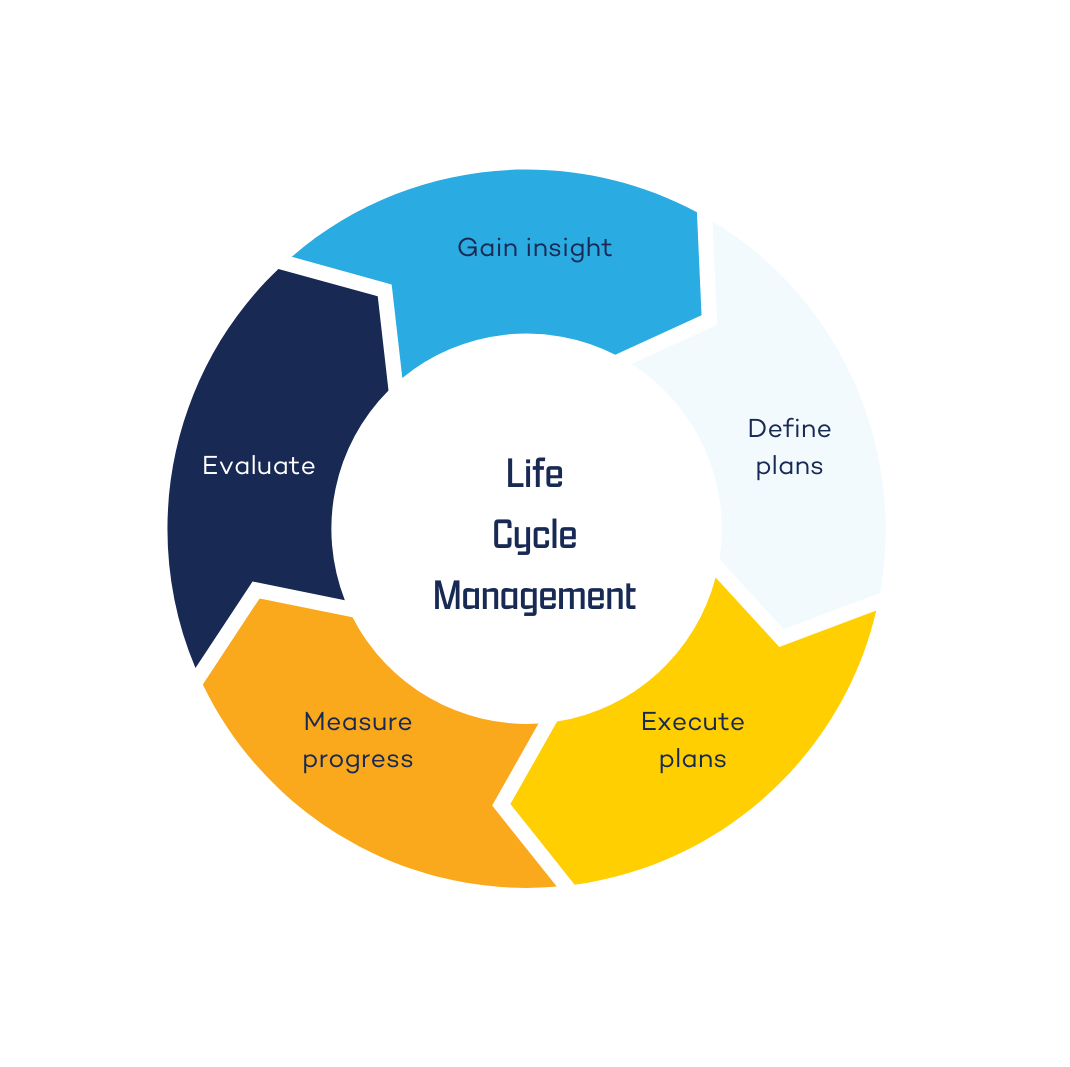
Life Cycle Management is a continuous and cyclical process.
It consists of the following steps:
1. Gain insight
2. Translate insight into plans.
3. Implement plans
4. Measuring progress and impact
5. Evaluate
Life Cycle Management within the portfolio
Life Cycle Management (LCM) must be part of project portfolio management.
For three reasons:
- Integrated Strategic Asset Management:
LCM provides a structured approach to managing the full lifecycle of assets (such as applications, buildings or vehicles).
By integrating LCM into Portfolio Management, organizations can make strategic decisions based on a holistic view of their entire asset landscape.
This helps in prioritizing investments, planning maintenance, and replacing or phasing out assets in a timely manner, thereby deploying resources more effectively.
After all, at the end of the day, regular portfolio projects and life cycle related projects all claim the same resources. - Improved risk management and cost optimization:
By integrating LCM into the portfolio management process, organizations can better manage risk by understanding the status, costs and performance of assets throughout their lifecycle.
This allows organizations to anticipate potential risks such as obsolescence, inefficiencies or increased costs in a timely manner, enabling cost savings and optimization and best ensuring continuity. - Strengthened decision-making and alignment with business goals:
LCM within Portfolio Management ensures that project planning and execution are aligned with asset life stages and business goals.
This ensures better decision-making by considering the impact of long-term changes, such as improving asset performance, regulatory compliance, and contributing to strategic goals such as sustainability and innovation.
Well-organized strategic portfolio management involves going concern projects, innovation and change projects and life cycle management.
Want to know more about how FCC supports life cycle management?
Request a personal demo via the button below
Continue reading...
Best Practices Paper Making choices under pressure of tasks at water authorities
Waterschappen delen in deze paper hun uitdagingen en best practices rond portfoliomanagement: prioriteren met expliciete criteria, capaciteit in beeld en vaker herijken. Gratis download.

Portfolio Management at Shimano Europe Group
Over the course of four years, the Shimano Europe Group grew from seventy separate Excel projects into a single professional portfolio. Read how Jan and Alessandra used Fortes Change Cloud to help this European PMO achieve better control, standardization, and data-driven decision-making.
Best Practices Paper: From Portfolio Insight to Portfolio Practice
Download the Best Practices Paper and discover how the portfolio maturity model can help you understand where your healthcare organization stands. The paper outlines the steps that can help you move toward greater structure, better decision-making, stronger alignment, and value-driven portfolio management.


