Agile organization
Major changes can jeopardize your organization’s reason for existence or revenue. Think of national health, technology, political conditions, or international relations. You need to be able to respond quickly and efficiently, even when managing a large change portfolio. How do you do that?

Strategic Portfolio Management
Strategic portfolio management enables continuous assessment of initiatives against evolving strategic goals. Strategic portfolio management means that the selection, timing, and continuation of (change) projects within the portfolio are continually reassessed and aligned with the strategic objectives. Tactical and operational activities are aligned with the strategy.
Short-cycle approach
When adopting strategic portfolio management, a shorter review cycle (monthly or quarterly) is generally chosen for the portfolio as a whole, so that resources can be flexibly reallocated.
(Scaled) Agile Management
In practice, many organizations have now embraced Agile working. However, at the executive level, decision-making is often still guided by longer planning cycles and fixed annual plans. This conflicts with the agility and iterative approach of Agile teams. If you want your organization to be truly effective, the strategic and tactical levels must also adopt Agile practices, for example, following the Scaled Agile Framework (SAFe). Only then can true alignment and agility be achieved throughout the entire organization.
Use of real-time data and dashboards
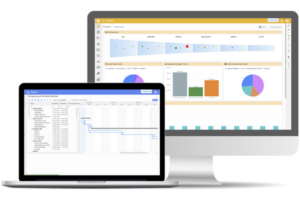
By moving away from static, periodic reports and relying more on real-time dashboards, you can identify bottlenecks sooner and make better adjustments at the strategic, tactical, and operational levels.
Discover Fortes Change Cloud